Los Angeles microclimates sustain aggressive populations of daytime-biting container breeders like the Asian tiger mosquito ( Aedes albopictus ) and the yellow fever mosquito ( Aedes aegypti ). Unlike native marsh…
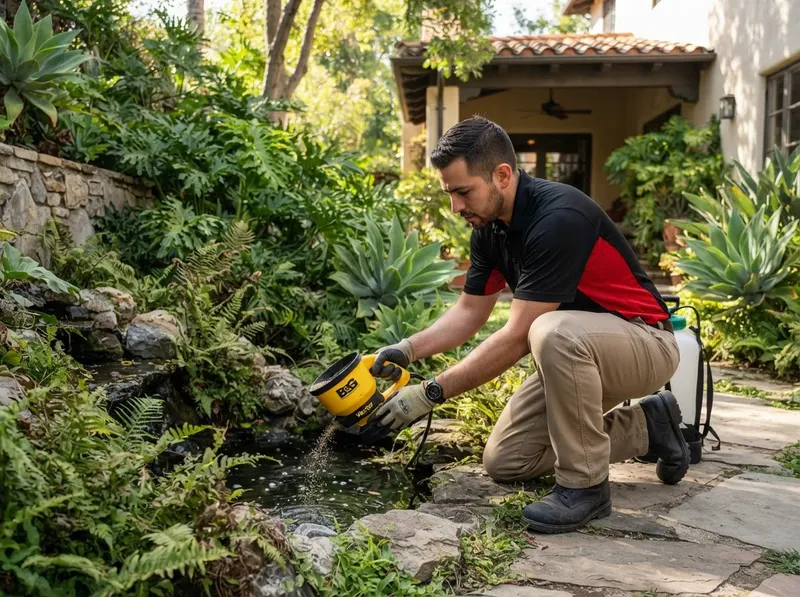
Los Angeles microclimates sustain aggressive populations of daytime-biting container breeders like the Asian tiger mosquito (Aedes albopictus) and the yellow fever mosquito (Aedes aegypti). Unlike native marsh varieties that travel miles from river floodplains, these invasive species complete their complete 7-to-10-day lifecycle within structural micro-reservoirs holding as little as a bottle cap of stagnant water. Structural topography across neighborhoods like Silver Lake, Los Feliz, and Highland Park creates hidden subterranean catch basins, where terraced retaining walls empty into perforated corrugated pipes. In coastal microclimates such as Venice and Pacific Palisades, heavy marine moisture keeps recessed footing channels perpetually damp, while dense tree canopies in Brentwood and Encino shield ornamental bromeliad pockets from evaporative drying. CopperLine Pest Services bypasses indiscriminate yard-fogging methods that collapse beneficial pollinator populations, focusing instead on structural vector disruption and perimeter fortification.
Effective suppression relies on physical alterations validated by the CDC Integrated Mosquito Management framework. Inspections examine subsurface landscape infrastructure where runoff settles invisibly. Typical residential targets include decorative water features, automated irrigation valve boxes in Sherman Oaks, neglected basement crawlspace sumps in Koreatown, and unsealed rain capture cisterns in Boyle Heights. Physical exclusion involves securing downspout adapters, installing sub-surface flow restrictors, and capping open access pipes with 1/16-inch monofilament wire mesh meeting ASTM E2016 woven wire standards. Where permanent drainage modification is physically unviable due to structural grading constraints, biological controls interrupt the pupation cycle using Bacillus thuringiensis israelensis (Bti), an environmentally selective soil bacterium registered under the Federal Insecticide, Fungicide, and Rodenticide Act that neutralizes aquatic mosquito larvae without systemic chemical residues.
Operational protocols integrate surveillance standards aligned with the California Department of Public Health Vector-Borne Disease Section and guidelines established by the Entomological Society of America. Urban runoff containing organic debris accelerates bacterial blooms that feed larval instars. By clearing sediment bottlenecks according to Los Angeles Regional Water Quality Control Board surface flow practices, residential parcels eliminate the biofilm mandatory for invasive oviposition. Technicians document every breach vector using digital photo mapping, detailing standing-water anomalies across terrace drains and structural deck footings, adhering to IPM principles cataloged by the UC Statewide IPM Program. If a subterranean drainage channel lacks positive gravity fall, remedial grading or auto-siphon pumps resolve moisture retention where larvicide dunks alone cannot sustain season-long suppression.
Every job gets a firm, written price after a free on-site visit.
For standards, safe disposal, and service guidance on pest control services in Los Angeles, CA, useful references include U.S. EPA, ENERGY STAR, U.S. Dept. of Energy, Consumer.gov, U.S. Census Bureau, and Google Maps. General consumer and small-business resources are available from USA.gov, Better Business Bureau, FTC Consumer Advice, U.S. Small Business Administration, and Ready.gov.
Tell us about your invasive mosquito source reduction job in Los Angeles and we'll send a clear, written quote, usually the same day.
 CopperLine Pest Services